


Low-voltage batteries
A low-voltage battery will only work with an inverter that can handle low battery voltage.
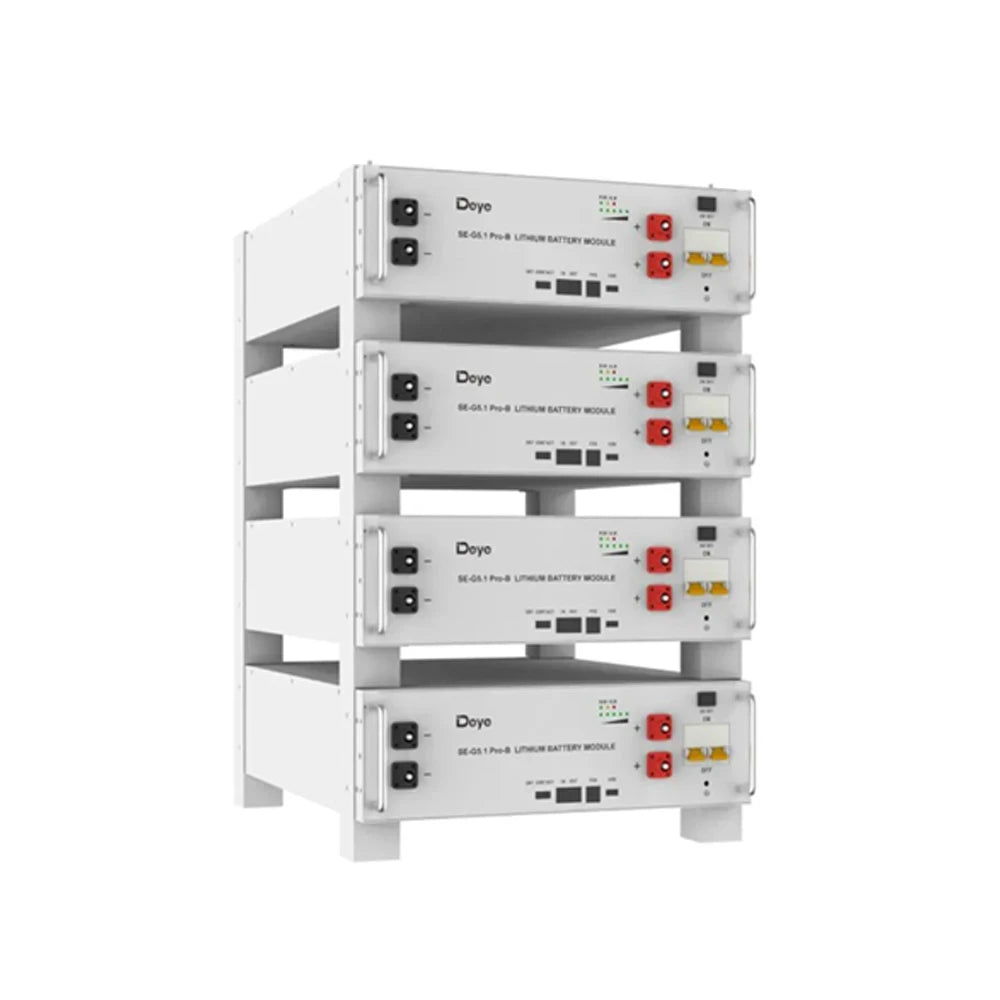
Deye SE-G5.1PRO-B


High-voltage batteries
A high-voltage battery requires an inverter that can accept the high battery voltage.
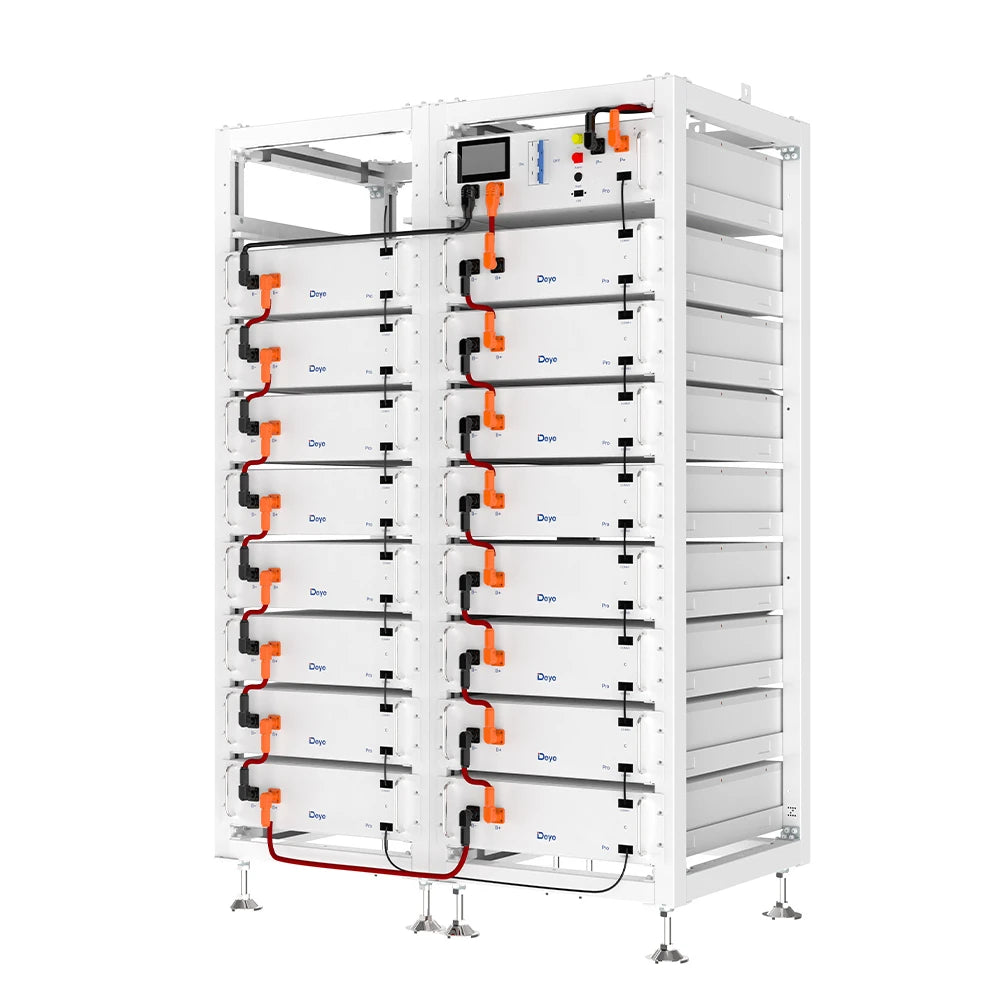
Deye BOS-G 5.1 PRO


Do you have a question?
Do you have any questions about Deye batteries? Contact us, we are happy to help.
Does the Deye hybrid inverter work automatically in the event of a power outage?
Does the Deye hybrid inverter work automatically in the event of a power outage?
Yes, most Deye hybrid inverters can switch to backup mode in the event of a power outage if the EPS/Backup output is installed and a battery is connected to the system. In this case, the inverter disconnects the property from the grid and powers the designated consumer circuit from the battery. The exact operation (switching time, load capacity) can always be found in the specific inverter's manual.
How do LV and HV batteries differ?
How do LV and HV batteries differ?
LV batteries (e.g., SE-G5.1PRO-B) operate at a nominal voltage level of approximately 48–51.2 V and are generally recommended for residential systems, lower power, and simpler installation.
HV systems (e.g., BOS-G Pro series) generate battery voltages between 200–500 V by connecting multiple modules in series, thus enabling higher power, greater system efficiency, and larger capacity – typically recommended for homes with heat pumps and high consumption, or smaller C&I systems.
How do I decide if I need an LV or HV battery?
How do I decide if I need an LV or HV battery?
The decision is primarily determined by the type of inverter your system uses.
LV batteries can only be used with LV-compatible inverters, and HV batteries with HV inverters.
In general:
- LV: for low-load, residential use
- HV: for high-consumption properties or industrial environments
Can the Deye inverter only be used with a Deye battery?
Can the Deye inverter only be used with a Deye battery?
Not necessarily, but it is highly recommended to follow the manufacturer's approved list. Deye hybrid inverters are compatible with lithium batteries from several manufacturers, but the manufacturer issues a separate "Approved Battery List" document and specifically requests that customers only use the types listed there, or consult with the manufacturer in advance. Otherwise, communication problems, error codes, and warranty issues may arise.
How long can the house run on a battery?
How long can the house run on a battery?
This always depends on the ratio of capacity (kWh) to current load (kW).
For example, a 10 kWh battery can power consumers for approximately 10 hours with an average load of 1 kW, but only about 5 hours with a 2 kW load. The actual value may be slightly less due to inverter losses and the reserve left by the BMS.
What is the lifespan and warranty of a Deye battery?
What is the lifespan and warranty of a Deye battery?
For example, the manufacturer provides a 10-year warranty and at least 6000 cycles for the SE-G5.1PRO-B LV battery (at 90% DOD, up to 70% capacity).
The BOS-G Pro HV modules also feature similar LFP technology, designed for several thousand cycles and a lifespan of more than 10 years.
The exact warranty conditions can always be found in the type-specific warranty certificate.
Is there remote monitoring and an app for Deye systems?
Is there remote monitoring and an app for Deye systems?
Yes. Deye hybrid inverters support Wi-Fi / LAN-based remote monitoring (Deye Cloud, Solarman, etc.), where energy flows, battery charge status, and error messages can be tracked online.
The SE-G5.1PRO-B battery module also supports remote monitoring and USB firmware updates independently, which facilitates servicing and long-term operation.
How long does it take to charge the battery with solar power?
How long does it take to charge the battery with solar power?
This depends on the solar panel's power and the battery size. As an example: an 5 kW solar panel system in ideal sunshine will charge a 5 kWh battery in approximately 1 hour, and a 25 kWh system in 4–6 hours. The actual time is influenced by the inverter settings and current consumption.
What kind of communication takes place between the inverter and the battery?
What kind of communication takes place between the inverter and the battery?
Most Deye systems use CAN or RS485 communication. This ensures battery protection, charge/discharge control, and error reporting. For this reason, only batteries that support a compatible communication protocol can be used.
Can multiple battery types be used simultaneously within the same system?
Can multiple battery types be used simultaneously within the same system?
No. The manufacturer strictly prohibits the use of different types of batteries or mixed connections. Always use modules of the same type and age to ensure system stability and long-term reliability.


